Halenur and I’s midterm was revised to fulfill the required word count.
Technology: Smartphones (software/operating system/apps)
Salient Identity: Age
Brandon Diaz & Halenur Komsul
Moore’s Law died in 2011 when a study from Science Magazine revealed that the peak rate of change in the world’s capacity to compute was in 1998. However, that doesn’t mean that the technological changes we see everyday aren’t significant. Somehow, the changes that have occurred after this peak may even be more worrying than all the developments prior, as they set a potential foundation for millions of evils and injustices at the hand of technology that goes unresearched.
One of the problems we face now is just that: the endless abilities that individuals with access to technology, specifically the smartphone, can unlock. This doesn’t sound like a problem, but when viewed from the lens of the potential decline of mental health, social abilities, and consequences of overstimulation specifically related to age, there is a lot to consider and unpack. Younger individuals might be far more susceptible to being diagnosed with anxiety, depression, or sleep disorders than older generations might have been, as a direct result of their smartphone usage during adolescence. This ie especially true consider it has been reported that about 53% of children in the United States have a smartphone by the age of 11. This means that children have access points to endless resources that can negatively stimulate the development of their brains. It also poses the risk of being exposed to untrue or overtly emphasized realities, which can also negatively impact their social and worldly understandings.
Although the gamut of affected individuals is extremely large, by nature of technological advancements and the unknown effects they might have, for this project specifically we will be focusing on users of various ages, starting with younger kids, around the age of 10, to adults around the age of 20, as well as adults who are above the age of 40 who are considered by the state of New York and Federal Law to be a “protected identity”. In this case, the “minority” groups are those who are outliers- individuals of any age group that do not engage with smart devices. This may be a result of economic disadvantage. This also references the risk of children viewing false realities and can encourage harmful ideologies, specifically for children of disadvantaged socioeconomic backgrounds who might have limited access to knowledge, to begin with, thus festering emotions of confusion, self-hate, and anger. However, because they are so young, these emotions might release themselves in the form of violence and other illegal activities, putting them at risk for much more as they get older.
This problem is important to the larger community of users because there is no true data or analysis of the effects that social media can have on younger users as they get older because the technology has never existed long enough to track the relationship between mental health and smartphone use at such a young age. This should be data that is investigated by companies that produce the technology to make sure they aren’t creating something that causes more harm than it does benefits. Currently, it seems much more like they are more invested in simply rolling out the tech and pushing themselves further without considering how far society is able to go with it.
Regardless of age, most Americans rely on a cellphone of some sort to communicate with friends, family, or to conduct business endeavors. Of the 96% of cellphone users, 81% have smartphones specifically. With the plethora of apps available for these devices, regardless of whether they run on iOS or Android, smartphones inevitably, and inherently, create issues for their users. Technically speaking, smartphones are simply just a brick of aluminum and glass with multiple systems of wiring that allow power to flow, fans to operate, and chips to function. Where the genius lies is in the coding and algorithms that are the operating system (iOS, for example). These operating systems act like computer operating systems, but on a smaller level, with relatively the same amount of effectiveness. These operating systems become home to tens and hundreds of apps, thousands of lines of code, and millions of bits of data. Now, not only can you make calls from your phone, but you can see what your friends are doing on vacation, control your home security system, or create digital art for your side-hustle.
The target market of smartphones reveals itself to be individuals with the financial ability to purchase them. Creators of this are Apple, Samsung, and Google, etc, beginning in 2007 with the introduction of the first iPhone. iPhone assembly occurs in China, while its design is constructed in Cupertino, California, and it is distributed worldwide.
As a result of the reach which these smartphones garner in terms of the volume of users they have, they range greatly in demographics and salient social identities. One of the main issues this causes on the creator end is to draft products that are universally desirable and accessible. Additionally, they keep their app store relatively open for independent creators to add their ideas to the market. With this, the issue of an overwhelming and chaotic environment is introduced. Users now have the power to download apps related to business, education, entertainment, finance, health and fitness, music, navigation, and news, all on one device while having the power to access them whenever and however they choose. Applying this more specifically to the salient social identity of age, we see even more problems arise. Will kids who now have access to all these stimulants maneuver differently within society than older generations did? Of course, there are also issue related to older individuals who might feel as if there are barriers that prohibit them from being able to access technology the way it was intended to be, by design. For instance, research has been done which recounts the stories of various older individuals who are limited in their ability to engage with their doctors and therefore restricted from accessing medication they need unless they become tech-savvy enough to use apps required by their healthcare providers to maintain contact. This raises the question of whether older individuals are second-guessing their competence and effectively feeling poorly about themselves because they are not “with the times”. This can also influence how these older individuals are regarded in society. The association between older generations and their relationship to technology, specifically smartphones, is typically negative. We have seen the inability to properly use their smartphone as the punchline of a joke time and time again. As a result, this can generate underlying ageist beliefs.
It’s important to recognize the ways these issues are being handled currently. One of Apple’s more recent iOS updates introduced a feature called Screen Time which not only keeps track of the time that the user spends on the phone, but also breaks down how much time is spent in each app used. Every week there is a weekly screen report presenting how much time the user spent staring at their screen; and for me, the numbers are always shocking. The feature also shows the percentage increase or decrease in the amount of time spent this week versus the week prior. Also, Instagram is planning to, and beta testing the disabling of users from seeing how many likes another user got on a post. Only the user who posted it can see. This may be a great help in reducing the need for people to compare their lives and appearances to one another when they can’t quantify how many people favor another’s over theirs. These are only a couple of the ways smartphone geared tech companies are trying to assess the potential dangers of smartphone misuse related to social media and overall consumption of digital media, which is a step in the right direction.
The National Institute of Mental Health is optimistic about new technology that can be packaged into an app for handheld smart devices. The NIMH says these apps might use the built-in sensors of these devices to collect the user’s information on their typical behavior patterns. “If the app detects a change in behavior, it may provide a signal that help is needed before a crisis occurs.” They also remind us of the existing apps that are stand-alone programs that promise to improve memory or thinking skills, as well as others that “help the user connect to a peer counselor or to a healthcare professional.”
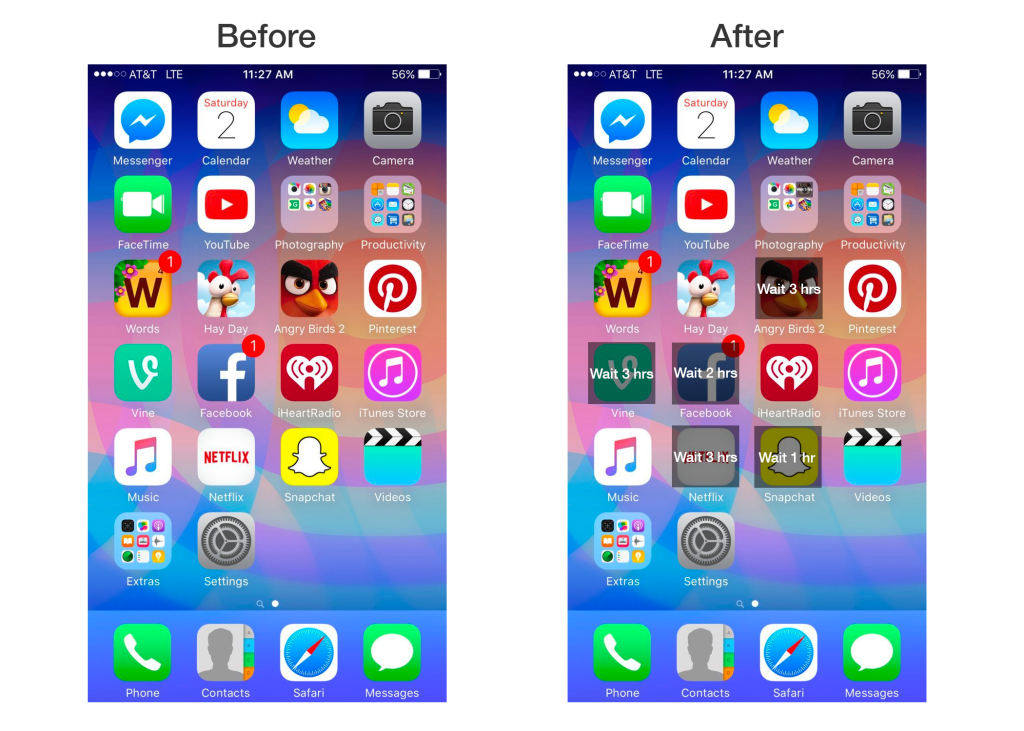
In a world where smartphones are integrated into our daily activities, and a part of the lens we see the world through, it may be difficult to come up with a solution to reduce usage that people would actually adopt. But perhaps the solution isn’t about getting people to WANT to reduce their usage but forcing them to, for the sake of salvaging what is left of their mental health in a world that already clearly profits and thrives off of its decline. Apple’s Screen Time may not be as effective in reducing the amount of usage as they may think. Screen Time may, at best, be a means of raising users’ awareness of their excessive smartphone usage; and while awareness is the first step to solving a problem, perhaps a more aggressive approach is needed.
On the other hand, Instagram has the right idea: not reducing the mental stimulation of seeing a photo that a user likes and actually “liking” it, but reducing the mental detriment that is caused by seeing the amount of likes another user received on a post. This is an example of forcing the user to “reduce usage.” The user is still USING the device, but “using” less of the harmful stuff. Simply put, the solution doesn’t have to be to delete these apps, or always keep one’s phone on ‘Do Not Disturb’, but rather to regain control over how influential these technologies can be on our perspectives.
NIMH’s idea of using built-in sensors of these devices to collect the user’s information on their typical behavior patterns is an interesting direction to take in forcing control of usage. A possible solution may lie in using artificial intelligence to monitor what it is exactly the user is using their phone for, similarly to Apple’s Screen Time, but taking things a step further. Rather than just monitoring how long someone is using an app, it will monitor what they’re using it for and recognize when it is becoming detrimental to their mental health. This type of technology will function on a case-by-case basis depending on the age of the user so it may be crucial in protecting developing brains and those who battle anxiety and other mental health issues that may be linked to smartphone users. It will work to discontinue the unhealthy relationships between users and smartphones while also recognizing where the user struggles with the technology and make its own accommodations for them based on their shortcomings. The beauty in a technology like this is that it uses technology to humanize us. One of the most recurring plotlines in science-fiction we have seen is the loss of humanity at the hands of technology, but what if we could use machine learning and artificial intelligence data analyzation to help regain that humanity?
An interview was conducted with Brandon’s stepfather, Jeff, who is a 44 year old male and owns an iPhone. He was chosen to be interviewed because he has been privy to the observation of the mental effects of smartphone usage through himself, his eleven year old son Constantine, and Brandon (22 years old).
When asked about his overall phone usage, he stated his use is relatively low. He barely makes calls and doesn’t send many texts. He did, however, say his phone usage has spiked compared to before he opened an Instagram account; most of his time on his phone is spent on social media. What is interesting to note is that while he claims he knows “he should find something better to do than scroll through Instagram”, he feels little to no effect of his increased phone usage to his mental health.
However, when asked about his observations of Constantine’s phone usage and the possible negative effects, Jeff admits that there is definitely a problem. He claims to observe “addictive behavior … he just can’t stop, can’t get off his phone.” It is important to note that Constantine is not on social media. He solely uses youtube and other entertainment apps along with texting. This can prove that the negative psychological effects of smartphone usage cannot be entirely credited to social media.
Taking it a step further, Jeff was asked if he notices a difference in behavior and attention span between Constantine and Brandon who are a decade apart in age. He claims there is a massive difference. “I’m always threatening to take his phone away. I never had that problem with you. Sure, you were always on your phone, but it didn’t seem like it was frying your brain. The kid is all over the place when he’s not on his phone; and when he’s on it, he’s doing five things at once flipping through apps like clockwork, but very quick. Ever since he got his hands on that phone he’s never been able to put it down. His teacher wants to have him evaluated for anxiety. I think he’s been overstimulated and needs a detox already, and he’s only eleven… It’s probably playing a role in his development of ADD.” This short conversation says a ton. There is a clear discrepancy between the negative psychological effects of smartphone usage between ages 44, 11, and 22.
No solution is ever perfect, especially when it comes to fixing technology with even more technology. With this solution specifically, there are various ethical and social implications to consider when moving forward with it. These include, but are not limited to: the technology having an adverse or inaccurate reading of an individual, and thus harming their mental health more than helping, as well as making the user feel less in control, rather than more in control, especially as they transition into using this technology. The next step in introducing this technology is to integrate it into society in a non-invasive way to ensure that they do not reject it. The potential that this technology can have is significant, however, the only way to reach that potential is to make sure it is what people want. One of the most pressing ethical issues to consider is whether this will scare people. They are already afraid of sharing data when it is related to receiving advertisements based on their own interests and searches, let alone having their phone understand what their intention is while they interact with it. Smartphones can be the future of communication and productivity in a positive way if we learn how to use it responsibly. This is not something that can, or should, be legislated. This is something that should be available for users who need or want it, on their own free will. There is hope for the progress of the integration of a technology like this into our everyday lives that will enable us to coexist harmoniously with these tech devices.
Works Cited
Culture, Learning, and Technology : Research and Practice, edited by Angela D. Benson, et al., Routledge, 2017. ProQuest Ebook Central, https://ebookcentral-proquest-com.proxy.library.nyu.edu/lib/nyulibrary-ebooks/detail.action?docID=4809824.
Demographics of Mobile Device Ownership and Adoption in the United States. Pew Research Center: Internet, Science & Tech, Pew Research Center, www.pewresearch.org/internet/fact-sheet/mobile/.
Kamenetz, Anya. “It’s A Smartphone Life: More Than Half Of U.S. Children Now Have One.” NPR, NPR, 31 Oct. 2019, www.npr.org/2019/10/31/774838891/its-a-smartphone-life-more-than-half-of-u-s-children-now-have-one.
Harvey, Philip D, and Richard Se Keefe. “Technology, Society, and Mental Illness: Challenges and Opportunities for Assessment and Treatment.” Innovations in Clinical Neuroscience, Matrix Medical Communications, Nov. 2012, www.ncbi.nlm.nih.gov/pmc/articles/PMC3552462/.
“Technology and the Future of Mental Health Treatment.” National Institute of Mental Health, U.S. Department of Health and Human Services, http://www.nimh.nih.gov/health/topics/technology-and-the-future-of-mental-health-treatment/index.shtml.
Presentation
https://docs.google.com/presentation/d/1ZWDPaWPCdHB__sJ_88fsiKt95uVVoxbtV2h413AZpcA/edit?usp=sharing
Images
Using the Technology

Salient Identity (Age)

Interviewees

Solution (or part of it):
Too much time spent on brain-frying apps? Here’s a step in the right direction.
 Diversity+Tech